
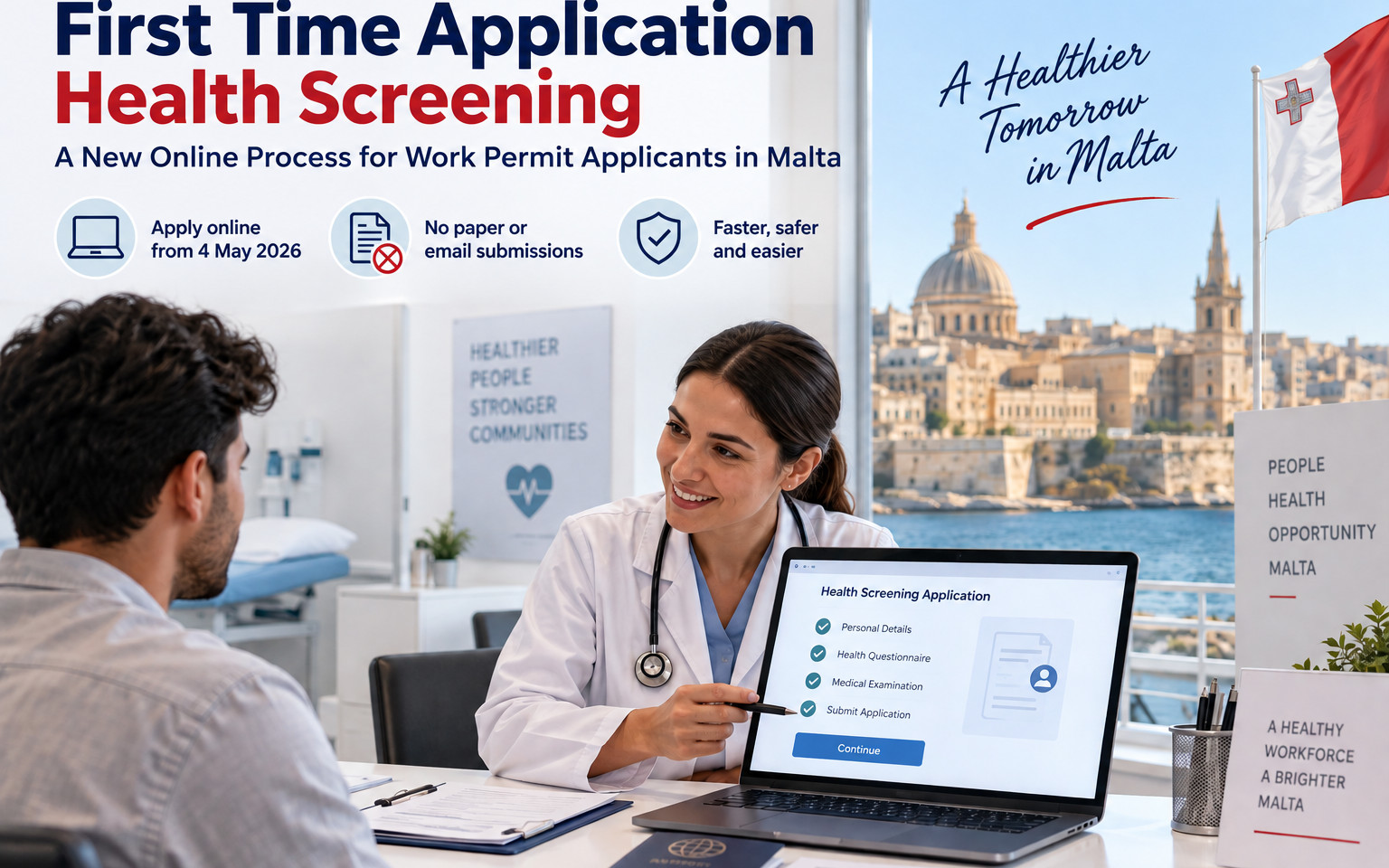
Malta introduced a mandatory online health screening process for work permit applications on 4 May 2026. Paper and email-based submissions are no longer accepted for new applications, applicable renewals or changes of job.
The change affects third-country nationals applying for permission to work in Malta. All non-EU nationals making a first-time work permit application must now obtain health screening approval, including applicants from low-risk tuberculosis countries and workers in occupations that were previously exempt.
The application must be started online by the employer or an authorised HR representative. The employee cannot initiate it personally. Medical tests, investigations and required vaccinations must be completed in Malta through private healthcare providers, and applicants should receive health screening clearance before booking their appointment with Identità.
Key point: From 4 May 2026, health screening for Malta work permits is an online, employer-initiated process. All first-time third-country national applicants require approval, and appointments with Identità should be booked only after full health clearance has been received.
What changed on 4 May 2026?
The previous paper-based procedure was replaced by an automated online system for work permit health screening.
The principal changes are:
applications must be submitted through Malta's Health Screening Portal;
paper forms and applications sent by email are no longer accepted;
all third-country nationals making a first-time work permit application require health screening approval;
applicants from low-risk TB countries in job categories that were previously exempt are now included;
the employer or HR representative, rather than the employee, must initiate the application;
an authorised doctor completes the medical component and uploads the supporting records online; and
clearance is issued electronically and must be presented to Identità.
Under the original transitional arrangement, a paper screening dated on or before 30 April 2026 could be accepted only if submitted by 5 May 2026. That transition period has now expired.
Who needs health screening for a Malta work permit?
All third-country nationals making a first-time work permit application must obtain health screening approval.
This includes applicants from low-risk TB countries seeking work in occupational categories that had previously been exempt, including:
administrative workers;
construction and manual workers;
footballers;
hairdressers and makeup artists;
transport workers;
cleaners and housekeepers;
security guards;
delivery personnel; and
laboratory technicians working outside the medical field, including construction, chemical and pharmaceutical laboratories.
Health screening may also be required when an employee changes job and for certain renewal cases. The exact requirements can depend on the applicant's occupation, country of birth and residence history.
Who must submit the application?
The health screening application must be initiated by the employer or its HR representative, not by the employee.
The employer or representative accesses the online system using eID and submits the relevant employee information. The occupational title selected in the portal should correspond with the title used in the Jobsplus application.
The employer or HR representative must upload:
the signed Employee-Employer Declaration Consent Form; and
a clear copy of the employee's passport biographical page.
The consent form must contain an original signature. A signature copied and pasted into the document is not accepted.
Food handlers must also provide scans of both sides of the Food Handler's Card issued by the Food Safety Commission, including the side containing the QR code. A Food Handler certificate is not accepted as a substitute for the card.
Missing, incorrect, incomplete or unclear documents can cause the application to be returned for correction and delay the process.
How does the online process work?
The main steps are as follows:
The employer starts the application. The employer or HR representative submits the employee's details and supporting documents through the Health Screening Portal.
The system generates the applicant's requirements. After submission, the employer can download a personalised medical checklist and a list of registered doctors and clinics authorised to complete online health screening.
A medical appointment is booked. Either the employer or employee contacts an authorised doctor or clinic directly.
The employee attends the appointment. The applicant must bring the original passport and all medical reports, test results and vaccination records identified in the checklist.
The doctor completes the online medical form. The doctor reviews the medical history and documentation, carries out the required examination and uploads the necessary records.
The application is reviewed. Final clearance must be granted by the doctor and the Infectious Disease Control Unit.
An approval email is issued. The employer and/or employee receives an automated notification confirming full clearance at the email addresses entered in the application.
Clearance is presented to Identità. The employee can proceed with the relevant Identità process using a printed copy of the approval email.
Only one doctor may complete the online health screening form. If more than one visit is necessary, the applicant should continue with the same doctor.
What should the employee bring to the appointment?
The applicant should bring:
the original passport — a photocopy or digital scan is not sufficient;
the personalised checklist generated by the system;
vaccination records;
medical reports;
relevant blood-test results; and
any other documents specified in the checklist.
The doctor or clinic may request the applicant's name, surname, ID-card number, passport number, residence-system number or unique HS code to locate the online application.
The HS code is generated when the employer submits the application and can be found beside the application in the portal's “In Progress” section.
Applicants who do not yet have an ID-card number or residence-system number may need to begin their residence permit application with Identità to obtain the required residence-system number.
Must the medical tests be completed in Malta?
Yes. All medical tests, investigations and vaccinations required by the screening process must be carried out locally in Malta through private healthcare providers.
All submitted documentation must be in English.
Official foreign vaccination records may be used as evidence of a completed vaccination course. However, the current rules can still require a booster dose to be administered in Malta.
Vaccination requirements
The applicable requirements depend on the applicant's occupation and circumstances. The personalised checklist generated after submission should always be followed.
Diphtheria, tetanus and polio
All applicants, regardless of occupation, must demonstrate the required protection against diphtheria, tetanus and polio. Applicants are also required to receive one polio/diphtheria vaccine dose in Malta.
Failure to comply can result in rejection of the health screening application.
Measles, mumps and rubella
MMR vaccination is mandatory for:
doctors, dentists, nurses and midwives;
professions complementary to medicine;
carers, including those working in healthcare settings, elderly-care homes and institutions;
nannies and child carers; and
all female applicants, regardless of occupation.
MMR immunity blood testing is no longer accepted as part of the screening process. Applicants must provide vaccination evidence or receive the required vaccinations.
Hepatitis B
Hepatitis B screening requirements apply to:
doctors, dentists, nurses and midwives;
professions complementary to medicine;
carers;
beauty therapists, beauticians, spa therapists and massage therapists; and
tattooists.
An HBsAg test must be completed before vaccination. A positive result requires confirmatory testing. Hepatitis B immunity testing is no longer accepted as a substitute for the specified process.
What if vaccination records are missing?
Where an applicant claims previous vaccination, official evidence must be provided.
If vaccination records are missing or incomplete, the applicant may be required to repeat the full vaccination course in Malta. A booster dose alone will not be accepted in place of a full course when no satisfactory record is available.
Applicants who completed the full vaccination course abroad must provide official records and may still be required to receive a booster dose in Malta.
Where a course requires several doses, the complete schedule must be followed. Failure to complete it before a required health screening renewal may lead to refusal of the renewal.
When is a chest X-ray required?
For a first-time application, a chest X-ray is required where the applicant was born in, or lived for at least six months in, a country classified as high or very high risk for tuberculosis.
The chest X-ray must normally have been taken within six weeks of the application date.
For a change-of-job case requiring further health screening, an earlier chest X-ray may be reused if it was taken within the previous year. If it is older than one year, a new X-ray is required.
The list of high- and very-high-risk TB countries is reviewed periodically. An applicant's requirements may therefore change if the risk classification of a country of birth or previous residence changes.
What happens when an employee changes jobs?
Further health screening may be required if the new position falls into a different occupational category with different medical requirements.
For example, a move from an administrative position to healthcare or food handling may trigger additional screening. A move within the same general category, such as from cleaner to driver, will generally not require further screening.
The employer should submit a Change of Job application through the Health Screening Portal. The system will determine whether another screening is required.
If the employee never completed health screening previously but now requires it because of the new role or changed eligibility rules, the application should be made as a first-time health screening application.
What happens when an employee changes employer?
A new health screening application is generally not required when the employee changes employer but remains in the same occupational category.
However, a health screening renewal may still be required if the employee falls within the renewal rules.
Is health screening required for renewals?
Not every work permit renewal requires another health screening. Where required, the repeat screening generally takes place one year after the first screening.
A health screening renewal is required for applicants who were born in, or lived for six months or more in, a country classified as very high risk for TB. This applies across all occupations.
Renewal screening is also required for certain professions, including:
doctors, dentists, nurses and midwives;
professions complementary to medicine;
carers;
nannies and child carers;
food handlers;
beauty therapists, beauticians, spa therapists and massage therapists; and
tattooists.
These applicants must also have completed the vaccination course required for their profession before renewal.
Workers in administrative, construction, transport, cleaning, security, delivery and other listed general occupations do not normally require a health screening renewal if they are not from, and have not lived for at least six months in, a very-high-risk TB country.
“Health screening renewal” should not be confused with renewal of the work permit or residence card. It is a separate medical-clearance requirement that applies only to eligible cases.
How long does health screening take?
A correctly completed application may take up to 15 working days to process.
The period runs from receipt of a correctly completed application. Missing documents, unclear passport scans, incorrect information or incomplete medical records may result in the case being returned for correction, delayed or refused.
Requests for urgent processing are not considered.
Applicants should therefore avoid booking an Identità appointment before receiving the health screening approval email.
Common errors that can cause delays
Employers and applicants should take particular care to avoid:
entering an incorrect nationality, country of birth, gender or occupational title;
using a job title that does not match the Jobsplus application;
entering an incorrect email address;
uploading an unclear passport image;
using a copied-and-pasted signature on the consent form;
uploading a Food Handler certificate instead of the required card;
failing to upload both sides of the Food Handler's Card;
attending the medical appointment without the original passport;
attending without the required medical or vaccination records; and
visiting a different doctor after the online form has already been assigned.
Incorrect core details may require the application to be withdrawn or aborted and submitted again from the beginning. This can mean another medical visit and additional cost.
How is approval confirmed?
Once both the doctor and the Infectious Disease Control Unit grant final clearance, an automated email confirming full clearance is sent to the email addresses entered in the application.
The employee should print the approval email and present it to Identità as evidence of health screening clearance.
Because notifications are sent only to the recorded email addresses, employers should check those details carefully before submission.
Can a work permit application proceed without completing the requirements?
All medical documents, examinations, tests and vaccinations required for the applicant's case are mandatory.
If the applicant does not provide the required documents, refuses or cannot complete a required medical investigation, or does not meet a mandatory vaccination requirement, the health screening application cannot be approved.
Abnormal medical results should be presented to the authorised doctor, who will guide the applicant and refer the case for any necessary further management.
Practical checklist for employers and applicants
Employer or HR representative
Start the application through the official Health Screening Portal using eID.
Use the occupational title submitted to Jobsplus.
Enter accurate contact and personal information.
Upload the originally signed consent form.
Upload a clear passport biographical page.
Upload both sides of the Food Handler's Card where applicable.
Download and provide the checklist, doctor list and HS code to the employee.
Monitor the In Progress and Needs Attention sections of the portal.
Employee
Keep copies of vaccination records, medical reports and test results.
Book an appointment with a doctor or clinic appearing on the authorised list.
Bring the original passport and every document on the personalised checklist.
Provide complete and accurate information during the appointment.
Continue with the same doctor if more than one visit is necessary.
Wait for full clearance before booking the Identità appointment.
Final takeaway
Malta's 2026 reform makes health screening a fully online and employer-led stage of the work permit process. The most significant change is that all third-country nationals making a first-time application now require health screening approval, including low-risk-country nationals in occupations that were previously exempt.
Employers should initiate the application early, verify every uploaded document and allow for up to 15 working days after a complete submission. Employees should organise their original passport, medical records and vaccination evidence before attending the authorised doctor.
Most importantly, health screening approval should be obtained before an appointment is booked with Identità.
Official sources
Identità: Mandatory Change to Health Screening Process (Work Permits Only)
HPDP: Health Screening for First-Time Work Permit Applicants
HPDP: Health Screening Renewals for Work Permit Applications
Official Health Screening Portal
Important notice
This article provides general information and does not constitute medical, legal or immigration advice. Requirements depend on the applicant's occupation, medical history, country of birth and residence history. Official guidance, TB-risk classifications and medical requirements may change. Employers and applicants should follow the personalised checklist generated by the official portal and check the latest Identità and HPDP guidance before taking action.
